Medical note: This article provides general educational information and does not replace an individual medical or surgical consultation.
A beard transplant can change how a man feels about his face. For men with patchy facial hair, scarring, or low density, it is often one of the few lasting solutions, and a good beard can really improve how a man comes across: it defines the jaw, adds maturity, and shapes a first impression before he’s said a word.
But the same procedure can go wrong through unnatural angles, poorly matched hair texture, or an over-harvested donor area, especially with an inexperienced surgeon or a technician-driven clinic. The risk is higher than with a scalp transplant, because a beard sits on the most visible part of the face. A bad hairline can be covered; a bad beard is on show every time a man meets someone new, and correcting it is slow, costly and not always possible.
Recent viral cases, including one widely discussed online as the Aryan Raj case, have made many men cautious, and asking “what if this happens to me?” is reasonable. But caution alone doesn’t help anyone choose better. This guide covers why beard transplants sometimes go wrong, how angle, direction and density shape the result, and what to ask before choosing a surgeon.
Quick Answer: Why Does a Beard Transplant Go Wrong?
A beard transplant can technically grow and still look unnatural. The most visible problems usually arise when transplanted hairs don’t follow the correct angle, direction, distribution, and facial-hair pattern. Other problems can include poor graft growth, an inappropriate beard design, visible skin irregularities, overharvesting of the donor area, scarring, and healing complications.
That’s why you should never judge a beard transplant’s success by graft numbers alone. A natural result requires three things to work together: the right patient and donor hair, the right beard design and recipient-site planning, and healthy graft survival and healing.
The simplest test is this: can you actually tell where the transplant begins? If the answer is no, the planning worked, no matter how many grafts you used.
What Is a Beard Transplant?
A beard transplant is a facial hair restoration procedure in which follicular units are harvested from a suitable donor area, most commonly the scalp, and transplanted into areas with sparse or absent facial hair.
It may be performed to improve a naturally sparse or patchy beard, increase beard or moustache density, restore hair over selected scars, reconstruct facial hair lost after trauma or surgery, correct congenital absence or reduced facial hair, or improve a previous beard transplant.
The principle may sound similar to scalp hair transplantation, but the aesthetic planning differs. On the face, even a few hairs growing at an unnatural angle can be conspicuous.
Why Is Beard Transplantation Technically Different From a Scalp Hair Transplant?
One of the biggest misconceptions about beard transplantation is that it is simply a scalp transplant performed on the face. It is not.
The moustache, goatee, cheeks, sideburns and jawline have different natural growth patterns. Hair direction can change considerably over a relatively short distance, and beard hairs also tend to emerge at a very acute angle. In a published review on beard and moustache reconstruction, AK Clinics’ own research described recipient-site angles of about 10 to 20 degrees along the skin plane, with direction and density adjusted by facial zone.
This means beard transplantation requires zone-by-zone planning rather than a single, uniform implantation pattern across the face. The surgeon is not simply deciding where hair should grow. The surgeon decides where each transition should begin, how flat the hair should lie, which direction it should grow, where density should increase or decrease, and how the transplanted hair will blend when the beard is both long and closely trimmed.
| Factor |
Why It Matters |
| Hair direction |
Each beard zone has its own natural growth pattern; chin, jawline, cheeks and moustache all differ |
| Angle |
Beard hair needs to sit close against the face. Too steep an angle and it sticks outward instead of lying flat |
| Density |
Grafts need to be distributed to create fullness without looking artificially placed |
| Donor hair quality |
Texture and thickness need to blend with the hair already there |
| Beard design |
The shape has to suit the face, not just fill the available space |
7 Ways a Beard Transplant Can Go Wrong
1. Hair Growing at the Wrong Angle
This is one of the hardest problems to overlook. Natural beard hair generally lies relatively close to the surface of the face. If recipient sites are too upright, transplanted hair may grow outward instead of following the skin’s contour. The follicle may survive perfectly; the problem isn’t that the hair failed to grow, it’s how it grows. This distinction matters because a clinic reporting good graft survival does not automatically mean that the aesthetic result will look natural.
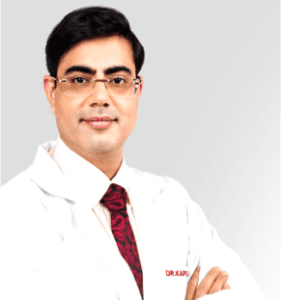
Dr Kapil Dua on Why the Slit Angle Decides the Result
“The slit, the incision you make to place the graft, is what decides the direction the hair grows in. For a beard, the slit needs to be almost parallel to the skin surface, not straight in. If the angle is correct, close to parallel, the hair emerges flat and natural, following the face’s contour. If the slit is cut too steeply, closer to perpendicular, the hair will still grow; the graft isn’t damaged, but it grows outward rather than lying down naturally. The hair did not fail. It is that the angle of the cut decided which way it was always going to grow.”
2. Hair Growing in the Wrong Direction
Angle and direction are related, but not the same. Angle describes how flat or upright the hair emerges from the skin. Direction describes where that hair points. The natural direction of facial hair changes across the face: moustache hairs generally follow a different pattern from cheek hairs, and cheek hairs behave differently from those along the jawline and goatee. If you use the same direction everywhere, the beard can look artificial even when density is good. This is why an experienced surgeon studies the patient’s existing hair pattern before planning the recipient sites.
3. Uneven or Artificial Density
More grafts do not necessarily produce a better beard. Natural facial hair isn’t identical in density everywhere. A good transplant recreates density gradients rather than filling the face like a uniformly planted field. For example, the cheek outline usually benefits from a softer transition, while central beard areas may need greater visual density. Too much density at the border can look hard and artificial; too little in the centre can leave the beard looking patchy.
The right question therefore is not “how many grafts will you give me?” It is “how will you distribute those grafts across my face?”
4. An Unnatural Beard Shape or Outline
A technically good transplant can still look wrong if the design does not suit the face. Plan a beard around facial proportions, jaw structure, existing beard pattern, the moustache-goatee relationship, sideburn transition, desired grooming style, and available donor hair. A perfectly straight cheek line or aggressively designed outline may photograph well immediately after surgery but look artificial when the transplanted hair matures. An experienced consultation should therefore involve actual beard design, not simply marking the empty areas and calculating a graft count.
5. Poor Match Between Donor Hair and Facial Hair
The donor hair also matters. Scalp and beard hairs are not identical. Beard hair is often coarser, and differences in shaft diameter, colour, curl and texture can affect how naturally transplanted scalp hair blends with existing facial hair. The donor area therefore needs assessment beyond the number of available grafts: consider hair calibre, curl, colour, follicular-unit characteristics, existing beard texture, and long-term donor availability. In some reconstruction cases, donor selection may require a more individualised strategy.
6. Skin Bumpiness, Cobblestoning or Visible Irregularities
Not every unsatisfactory beard transplant is caused by hair direction. Skin-surface irregularities can also occur. Published literature on beard and moustache reconstruction describes possible complications such as localised bumpiness, cobblestoning, redness, swelling and misdirected grafts. These irregularities may be particularly noticeable around the moustache, chin, and the region below the lower lip. Technique, recipient-site size, graft preparation, implantation depth and healing can all influence the final surface appearance.
7. Donor-Area Damage or Overharvesting
The beard is the recipient area, but don’t forget the donor area. Removing too many follicular units, or harvesting them poorly, can leave visible thinning or an irregular appearance in the donor region. A responsible transplant plan therefore has two cosmetic responsibilities: create an improved beard without creating a new problem at the back of the scalp. Donor supply is finite, which matters even more in younger patients or anyone who might need future hair-restoration surgery. When scalp donor supply is limited, body hair transplantation is also an option, which we cover in more detail on our beard transplant service page.
Does Poor Graft Growth Mean a Beard Transplant Has Failed?
Not necessarily, and timing matters. Transplanted hairs commonly shed early after surgery, and new growth develops gradually rather than immediately. Published beard-transplant literature describes visible new growth beginning from around the third month and continuing to improve over approximately a year. Do not label a result a failure simply because the beard looks sparse during the early postoperative months.
Poor final growth, however, may occur because of problems with graft harvesting, handling, implantation, recipient tissue or healing. A surgeon should distinguish between normal postoperative shedding, delayed growth, reduced graft survival, and an aesthetic problem despite good graft survival. These are not the same problem and may require different solutions.
What Can We Learn From the Viral “Aryan Raj” Beard Transplant Case?
A widely shared series of social-media videos involving a young man commonly identified online as Aryan Raj has led many patients to search terms such as “beard transplant gone wrong” and “failed beard transplant.”
The concern these videos raise is understandable. However, a responsible medical assessment cannot diagnose precisely what happened in an individual patient’s surgery from social-media footage alone. We do not have the complete clinical history, operative details, examination findings or long-term follow-up.
Public attention focused not simply on whether the hair grew, but on how it looked once it did. Two problems stand out in the publicly shared footage: hair growing in inconsistent, unnatural directions, and patchy, uneven density. This is exactly where the distinction between hair growth and a natural result matters. A graft can grow perfectly well and still draw attention if it doesn’t follow the natural flow of the cheek, chin, or jawline, and a beard sits directly on the face, so there is nowhere for a planning mistake to hide.
This is not a one-off observation. A separate AK Clinics case involving beard reconstruction over acne scarring showed the same principle in practice, noting that scar tissue requires extra care to keep slits at the lowest possible angle, since harder, less pliable skin makes the angle drift more easily without deliberate correction.
Rather than focusing on one individual case, patients considering surgery should use the discussion to ask better questions before their own procedure: beard transplantation needs careful planning of direction, density and overall facial pattern before a single graft is placed, not after.
What Should a Natural Beard Transplant Look Like?
The simplest test is this: it should not look transplanted. A successful result should ideally follow the natural direction of surrounding facial hair, lie at an appropriate angle against the skin, blend transplanted and existing hair, have gradual and believable density transitions, complement the patient’s facial proportions, look natural when grown, continue to look believable when trimmed short, and preserve a cosmetically acceptable donor area.
The goal isn’t to create the maximum possible beard. The goal is to create a beard that looks as though it could have grown naturally on that face.
Why Graft Count Alone Is a Poor Way to Choose a Beard Transplant Clinic
Patients often compare clinics based on statements like, “Clinic A is giving me 2,500 grafts while Clinic B is giving me 3,000.” That comparison can be misleading. The number of grafts required depends on beard density, the surface area needing treatment, the desired style, hair calibre, donor availability, moustache and goatee requirements, whether scars are being treated, and whether the surgery is primary or corrective.
Two patients with the same number of grafts may require completely different distributions. For beard transplantation, where and how grafts are placed is as important as how many are placed.
Case Example: Beard Restoration After Cancer Surgery
Beard restoration matters beyond cosmetic preference too. In one AK Clinics case, a carcinoma survivor underwent beard transplantation to restore facial hair lost to a flap graft surgery following cancer treatment. Dr Aman Dua harvested and placed 2,400 grafts, with close postoperative monitoring to guide healthy growth. The case shows how the same principles of direction and density apply even when working around scarring and altered skin.
Can a Failed Beard Transplant Be Corrected?
Sometimes, but not every case is equally correctable. The first step in revision surgery is identifying what is actually wrong. A corrective assessment should examine the direction of existing transplanted hairs, angulation, beard shape, density distribution, skin irregularities, scarring, donor-area condition, the number and quality of remaining donor grafts, and time elapsed since the original procedure.
Depending on the problem, a revision strategy may involve removing selected grafts, adding carefully placed grafts to improve blending or density, redesigning portions of the beard, or addressing associated skin irregularities. Some cases require more than one stage, and sometimes the safest recommendation is to wait before operating. This is why patients unhappy with an early result should avoid rushing into another transplant before the first procedure has fully matured.
Beard Transplant Over Scarred Skin Requires Additional Planning
Surgeons sometimes perform beard restoration after trauma, burns, previous surgery, cleft-lip repair, selected stable scarring conditions, or cancer-related reconstructive procedures. This is not the same as transplanting into normal facial skin. Scar characteristics, vascularity, and tissue mobility can affect surgical planning and graft survival, and surgeons must ensure the underlying condition is stable before considering surgery. In selected scar cases, surgeons may even assess a small area first before committing to larger reconstruction.
This shows why beard transplantation should start with a diagnosis and examination, not an online graft quote.
AK Clinics’ Research and Experience in Facial Hair Restoration
Facial hair transplantation is not a newly adopted procedure at AK Clinics. Dr Kapil Dua and Dr Aman Dua published “Facial Hair Transplantation” in the Hair Transplant Forum International in 2015, discussing the planning and technical differences involved in beard and moustache transplantation. They subsequently authored the peer-reviewed review “Beard and Moustache Reconstruction,” published in the Indian Journal of Plastic Surgery in 2021, covering facial anatomy, patient selection, donor harvesting, recipient-site creation, zone-specific beard planning, implantation, postoperative care and potential complications.
Dr Kapil Dua is also a listed co-author of the ISHRS FUE Clinical Practice Guidelines, the International Society of Hair Restoration Surgery’s official reference document for follicular unit excision technique. He has conducted ISHRS-supported research examining how long a graft remains outside the body before implantation affects its overall survival and growth rate in FUE, a question directly relevant to why technique, not just graft count, determines outcome quality. He has authored more than 40 national and international publications, co-edited the textbook Hair Transplantation (JP Publishers), and served terms as President of ISHRS, AHRS India and the Asian Association of Hair Restoration Surgeons (AAHRS).
Beard transplantation is not simply a cosmetic service offered alongside scalp transplantation. It requires its own anatomical understanding, recipient-site planning, and surgical judgement.
How to Choose a Beard Transplant Surgeon: 10 Questions to Ask
Before deciding where to have surgery, ask:
- Who will design my beard? The design should be individualised to your facial proportions and existing growth.
- Who creates the recipient sites? Ask specifically who determines the angle, direction and distribution of transplanted hair.
- How will you plan each facial zone? Don’t treat the moustache, cheek, goatee, sideburn, and jawline as one uniform area.
- Can I see mature beard-specific results? Do not rely only on scalp hair-transplant photographs; look for results at an appropriate long-term follow-up.
- Can I see results with the beard trimmed short? Long hair can conceal some irregularities; short-beard photographs can reveal direction and distribution more clearly.
- How was my graft number calculated? The surgeon should be able to explain the proposed distribution, not just quote a number.
- Is my donor hair suitable? Consider texture, calibre, and donor reserve.
- What happens if the result needs revision? A good clinic should discuss limitations and correction possibilities before surgery, not only after a problem develops.
- What complications should I know about? No responsible surgeon should describe a cosmetic surgical procedure as risk-free.
- Who is medically responsible for my surgery and follow-up? This should be clear before you pay a deposit or enter the procedure room.
Red Flags Before a Beard Transplant
Be cautious if a consultation focuses heavily on maximum grafts, discounted packages, immediate booking pressure, guaranteed density, guaranteed results, or a single standard beard shape for everyone.
Also reconsider if nobody has properly examined or discussed your existing beard direction, facial proportions, donor hair quality, scar history, medical history, realistic density, the possible need for more than one session, risks and limitations, or long-term donor planning.
A technically complex facial procedure should involve more discussion than a graft quotation over WhatsApp.
What Is More Important: Surgeon Skill or the Technique Name?
Patients often begin by asking, “Is FUE better or DHI better for a beard?” That may not be the most useful first question. FUE primarily describes how follicular units are harvested; surgeons can then use different methods for recipient-site creation and implantation.
For a natural-looking beard, key determinants include patient selection, beard design, recipient-site direction, angulation, graft selection, density distribution, graft handling, surgical execution, and postoperative care. A branded technique cannot compensate for poor planning.
When Should You Seek an Opinion After a Beard Transplant?
Consider speaking to an experienced hair-restoration surgeon if you are concerned about hairs growing visibly outward, markedly inconsistent hair direction, an unnatural beard outline, persistent patchiness after adequate maturation, significant asymmetry, visible donor-area depletion, persistent skin irregularities, scarring, signs of infection, or a result that remains cosmetically unacceptable after maturation.
Early redness, crusting, shedding, and incomplete density are not, by themselves, evidence of transplant failure. If pain increases, redness spreads, pus appears, you develop a fever, or you have another acute postoperative concern, contact your treating medical team promptly rather than waiting for the cosmetic result to mature.
Key Medical Takeaway
A beard transplant can meaningfully change how someone looks and feels, but graft numbers alone never define the best results. Direction, density, beard design, donor hair quality and careful planning all have to work together.
The viral Aryan Raj case has made many people more cautious, and that caution is not necessarily a bad thing. The real lesson isn’t that beard transplants fail; it is that before choosing surgery, you should understand exactly how your beard will be designed, how each facial zone will be planned, and what a realistic result looks like for your face.
Before asking “how many grafts will I get?” ask “who is deciding exactly where every group of grafts should go, at what angle, in what direction and at what density?” That question gets much closer to what determines whether the eventual beard simply grows, or actually looks natural. For facial hair restoration, the best result usually attracts the least attention to the surgery itself.
Considering a Beard Transplant or Correction?
If you are considering your first beard transplant, or are concerned about the result of an earlier procedure, start with a proper assessment rather than another graft-count estimate. Patients can consult the hair-restoration team in Delhi, Ludhiana or Bangalore for an individual assessment. Call: +91 97799 44207 | WhatsApp: +91 97790 28861
Frequently Asked Questions
A beard transplant is a facial hair restoration procedure in which hair follicles are taken from a suitable donor area, usually the scalp, and transplanted into areas of the beard with sparse, patchy or absent growth.
An incorrect angle or direction is one cause, but not the only one. Poor beard design, inappropriate density distribution, graft selection, skin irregularities and donor-recipient mismatch can also affect the result.
The orientation of recipient sites strongly influences the eventual direction and angulation of transplanted hair. Beard hairs normally require a very acute angle so they follow the face’s contour rather than projecting outward.
Growth is gradual. Initial shedding can occur, with new growth developing from around the third month onward. Final evaluation generally requires adequate maturation rather than judging the transplant during the early postoperative period.
Selected cases can be improved, but correction depends on the position and number of abnormal grafts, skin condition, donor availability and overall beard design. Revision planning needs an individual examination.
Yes, in selected cases. Facial hair transplantation has been used for scars caused by trauma, burns and surgery, but scar quality and the underlying condition must be evaluated before deciding whether transplantation is appropriate.
There is no universal number. The requirement depends on the amount of existing facial hair, size of the treatment area, desired density, hair characteristics and donor availability. A limited patch may require relatively few grafts, while extensive reconstruction may require several thousand.
Cost varies according to graft count, the area being restored, case complexity, and the clinic performing the procedure. No single figure applies to everyone; clinics usually need an assessment before they can give an accurate estimate.
Yes. It can also restore or improve the moustache, sideburns, and other facial-hair areas, including areas where hair has been lost due to scarring, surgery, or other medical causes.
Transplanted follicles that successfully establish themselves can continue producing hair long term. However, graft survival and the cosmetic quality of the final result depend on multiple surgical and patient factors.
Once the transplanted follicles have healed and matured, you can generally trim and groom the resulting hair like other facial hair. Your surgeon should provide specific postoperative instructions on when you can safely resume shaving.
Beard transplantation is a surgical procedure and therefore is not risk-free. Temporary swelling, redness, and crusting can occur, while less desirable outcomes may include irregularity, poor direction, inadequate growth, scarring, or other complications. Appropriate patient selection, sterile technique and experienced surgical planning help reduce risk.
Last Reviewed: October 2026 by Dr Aman Dua, MBBS, MD Dermatology, FISHRS
Medical note: This article provides general educational information and does not replace an individual medical or surgical consultation.
Medical References
Dua K, Verma V, Dua A. Beard and Moustache Reconstruction. Indian Journal of Plastic Surgery. 2021;54(4):483–488. doi:10.1055/s-0041-1739248.
Dua K, Dua A, Kothottil R. Facial Hair Transplantation. Hair Transplant Forum International. 2015;25(4):133–142. doi:10.33589/25.4.0133a.
Mysore V, Kumaresan M, Garg A, Dua A, et al. Hair Transplant Practice Guidelines. Journal of Cutaneous and Aesthetic Surgery. 2021;14(3):265–284.
Crisóstomo M, Dua K, Gupta AK, Mohebi P, True RH, Williams KL. FUE Clinical Practice Guidelines. Hair Transplant Forum International. 2019;29(4):139–150.









Leave a Comment