Medical disclaimer: This article is intended for general educational purposes and does not replace an individual medical consultation. Hair transplant suitability, graft requirements, treatment choice, cost, and recovery vary by patient.
India is a reliable choice for specialised healthcare, with highly qualified doctors, experienced hair transplant surgeons, and clinics that offer advanced hair restoration techniques. For someone researching a hair transplant in India from Australia, it lets you look beyond location and compare what matters most: the surgeon, treatment approach, quality of care, and overall cost.
The cost is obviously part of that discussion. Since the cost of living in Australia is high, cosmetic hair restoration is usually paid for out of pocket. It is therefore reasonable to consider what you could buy for the same amount of money elsewhere. Because India has a different cost structure, specialised hair restoration can be more affordable there, though price is not the only factor that encourages people to go there.
Your hair also requires an individual evaluation, as Australian patients, whether of Caucasian descent or not, can have quite different hair textures, shaft thickness, density, and hairline needs. The presence of these features, together with the degree and likely progression of hair loss, will affect how a transplant is planned.
Next, let’s compare getting a hair transplant in Australia with going to India, focusing on the factors that really make a difference, such as the surgeon’s skill, treatment cost, techniques used, and travel and recovery.
What Makes India the First Choice for a Hair Transplant?
A long flight for a hair transplant needs a stronger reason than a lower quotation. India has specialised hair restoration centres and doctors whose work extends beyond everyday clinical practice to include research, international training, and professional hair restoration organisations.
This means you have more choice in who treats you. Before you decide, check the surgeon’s qualifications, experience, published work, and long-term results for patients. Also, find out who will assess you, design your hairline, and perform the most important parts of the surgery.
Hair restoration has been one of AK Clinics’ main areas of focus since 2007. Dr Kapil Dua, who is the Chairman and Chief Hair Transplant Surgeon, holds qualifications in MBBS, MS, FISHRS, and Diplomate ABHRS, is a Past President of the International Society of Hair Restoration Surgery (ISHRS), and has extensive surgical experience, as well as having participated in international education and professional organisations related to hair restoration. He is also a co-author of the ISHRS FUE Clinical Practice Guidelines. Dr Aman Dua, with an MBBS and an MD in Dermatology, and who is FISHRS-qualified, has more than two decades’ experience in dermatology, hair loss, and hair restoration.
Since you are travelling so far for treatment, it is important to know who is making the clinical decisions.
How Much Does a Hair Transplant Cost in Australia vs India?
The price difference between Australia and India can be considerable, but the quoted figure does not tell the whole story. The surgeon’s experience, the technique used, treatment details, and your specific needs can all affect the final cost.
There is a big difference in prices depending on the surgeon, clinic, and technique used, but present-day market prices do offer a good basis from which to start (why is there a difference? It is due to the underlying cost structure, not the quality of the work itself):
| Cost Factor |
Australia |
India |
| Indicative treatment cost |
Generally higher, priced per graft (around AUD 4–10) |
At AK Clinics, treatment starts from ₹50,000 onwards, with the final cost confirmed after assessment |
| Surgeon fees |
High |
Comparatively lower |
| Clinic operational costs |
High |
Lower |
| Staffing costs |
High |
Lower |
| Currency exchange benefit |
Not applicable |
Can work in your favour as an AUD-based patient |
| Follow-up |
Usually local |
Check international follow-up arrangements |
*Australian figures are indicative market ranges, not AK Clinics quotations. Actual costs vary by surgeon, clinic, technique, and individual treatment requirements.
India’s healthcare cost structure can make specialised treatment more affordable. Do not judge one clinic against another solely on the price of the graft.
At AK Clinics, we draw up quotations based on a clinical evaluation. Our doctors assess your hair loss pattern, available donor hair, hair type, and the area that can realistically be covered before discussing the treatment plan and expected cost.
When calculating the total cost of a hair transplant in India from Australia, you should also account for return flights, accommodation, local travel, and any necessary tests or medications. After reviewing the final figure, consider who will perform the procedure, what is included in your treatment, and the surgeon’s experience relevant to your case.
The lowest quote isn’t necessarily the best value. Cost makes more sense when you consider it alongside expertise and the treatment you receive.
How Do You Choose the Right Hair Transplant Surgeon in India?
Technique names, clinic advertisements, and before-and-after photographs can quickly start to look alike. Begin with the doctor.
Before choosing a surgeon, check:
- Qualifications and experience: look specifically for experience in hair restoration, not only a general medical qualification
- Role in your surgery: ask who assesses you, designs the hairline and performs the critical surgical steps
- Documented results: look for cases that show the treatment journey and longer-term progress, not only immediate photographs
- Professional involvement: research, publications, international training and recognised hair restoration organisations can add useful context
- Long-term approach: a transplant should make sense not only for how your hair looks today, but also for how your hair loss may progress
Check the surgeon’s qualifications, hair restoration experience, role in the procedure, documented results, and approach to long-term planning. When travelling abroad, it helps to know who will treat you before you book your trip.
A Real Hair Transplant Journey from Australia
Credentials tell you about a doctor. A documented patient journey shows how they apply that experience in practice.
Debobroto Gorai travelled from Australia to AK Clinics with Grade 6 hair loss. After Dr Kapil Dua assessed him, he planned his restoration in stages rather than trying to address extensive hair loss in a single procedure.
His journey included:
- Grade 6 hair loss
- Treatment planned by Dr Kapil Dua
- Bio-FUE™ hair transplantation
- Three planned sessions
- 9,692 grafts across the complete treatment
- Approximately three years of documented progress
What matters most isn’t the number of grafts; his case shows that severe hair loss may require a step-by-step approach and careful use of the donor supply over time.
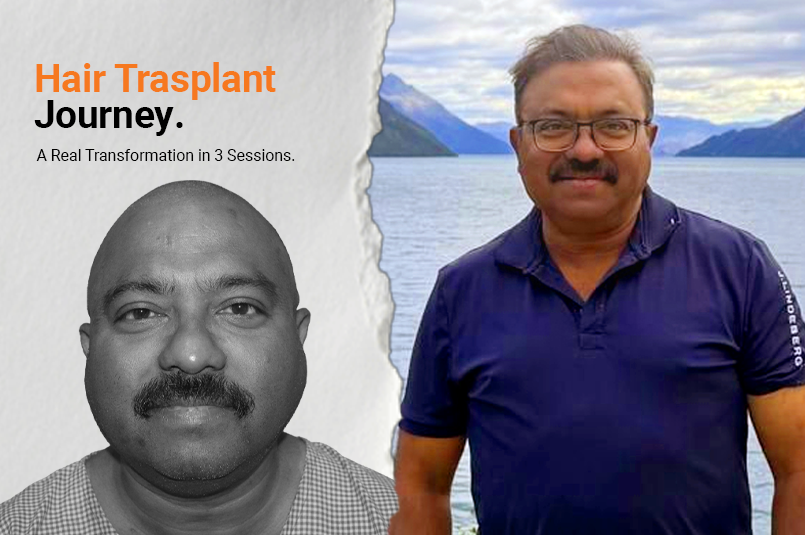
See the full case study of his Grade 6 Bio-FUE™ hair transplant to get an overview of the treatment journey and progression.
For an Australian patient considering treatment abroad, a real example from someone who has taken the same route can offer useful information beyond what the clinic provides.
Your Hair Characteristics Matter More Than Your Passport
Even if two individuals have about the same amount of hair loss, they may still require very different treatment programmes. Hair density, texture, follicular unit features, colour contrast, and growth direction can all influence the surgeon’s approach to the transplant.
This point is especially important when considering Caucasian patients who are travelling to India. Because there is no single type of Caucasian hair, surgeons must consider both anatomical features and hair characteristics when planning the operation.
What Differences Are There in Planning a Hair Transplant in Caucasians?
- Hair and scalp contrast: lower contrast between the hair and underlying scalp can sometimes help create the appearance of better coverage
- Follicular-unit characteristics: the number of hairs within individual follicular units can vary between ethnic groups and individuals
- Hair calibre and texture: fine, coarse, straight, wavy or curly hair can affect both extraction and the visual appearance of density
- Hairline design: facial and skull proportions can influence the shape of a natural-looking hairline and the frontotemporal angles
- FUE extraction: follicle shape, direction and curl can affect extraction, which is why experience with different hair types matters
These differences aren’t just cosmetic details. They can influence extraction, placement, hairline design, and how much visual coverage you can create from the available donor hair.
AK Clinics has already outlined these points in its clinical discussion of hair transplantation in Caucasian patients.
Is Hairline Design Different for Caucasian Patients?
It can be. Hairline design should always be individual, but clinicians consider facial proportions, skull shape, the existing hairline, and frontotemporal angles when planning a natural result. Caucasian scalps are often associated with a more ovoid or elongated skull shape, which can influence frontotemporal hairline planning.
The important point is not to design a “Caucasian hairline” from a template. Your surgeon should design a hairline for your face, existing hair and long-term pattern of hair loss.
Can Caucasian People Have a Hair Transplant in India?
Yes. The surgeon should understand the characteristics of the hair in question and can adjust the surgical plan as needed; your diagnosis, donor hair availability, follicle features, medical history, and hair loss pattern matter more than your nationality alone.
For Australian patients, this is another reason to choose a surgeon experienced with international and diverse ethnic hair types rather than selecting a clinic solely based on location or price.
Technique Comes After the Treatment Plan
While technique matters, the most advanced-sounding option isn’t always the right choice; the surgeon should recommend a method after understanding your hair loss and treatment goals.
Hair Transplant Options at AK Clinics
FUE: individual follicular units are extracted and transplanted to the intended area, without leaving the linear scar in the donor region associated with strip surgery.
Bio-FUE™ is one of our finest hair restoration methods, featuring precise extraction, placement, and careful graft handling. We can use the AK Flat Punch whenever clinically appropriate.
Clinically, we can evaluate concerns after a previous hair transplant, such as an unnatural hairline, poor hair growth, or visible gaps, and take corrective action.
Which Hair Transplant Technique Is Right for You?
Instead of choosing by name, ask:
- Why is this technique suitable for my case?
- Who performs the critical steps?
- What can realistically be achieved?
- Can my previous hair transplant be corrected, if needed?
Our surgeons select the technique as part of the overall treatment plan, rather than treating the technique itself as the reason for surgery.
Your Assessment Can Begin While You Are Still in Australia
You don’t need to take a long-haul flight just to find out whether surgery might be suitable; you can start the initial assessment before making your travel plans.
This is especially useful for patients planning a hair transplant in India and arranging a return visit home. We also serve non-residents and international patients from the Middle East and other parts of the world; we can handle much of the initial coordination remotely.
You may be asked to share:
- Clear photographs of the front, top, crown, sides and back
- Your hair loss and treatment history
- Current medicines and relevant medical conditions
- Previous hair transplant details, if applicable
- Medical records or blood reports, when required
Can I Have an Online Hair Transplant Consultation Before Travelling to India?
Certainly. With an initial online consultation, the doctor can review your medical history and photographs, discuss treatment options, and answer your questions before you decide to proceed.
After carrying out a personal examination, the doctor agrees on the final surgical plan.
Before You Leave Australia
Once your dates are discussed:
- Carry relevant medical records and prescriptions
- Complete blood tests before travelling if advised, or arrange them after arrival
- Check the appropriate Indian visa requirements for your passport
- Keep an international payment option available
- Plan flights and accommodation around your treatment dates
When possible, we suggest arriving two to three days before the procedure so you have time to recover from the journey, meet the team, and complete any remaining tasks before surgery.
If needed, our patient advisors can also recommend nearby hotels and diagnostic centres.
For a general introduction to planning treatment as an Indian living abroad, see our guide on Hair Transplant in India for NRIs: Cost, Choosing a Surgeon, Procedure & Travel Guide.
Plan the Journey Home Around Your Recovery
For an Australian patient, the journey home may involve several hours in the air, airport transfers, and, in some cases, connecting flights, so plan that part of the journey before you leave.
We suggest that you plan on spending at least 10 to 12 days in India:
- 1 or 2 days to adjust to your new environment after you have arrived and to carry out your face-to-face consultation
- Up to 2 days for the procedure itself since, in the case of a larger graft plan, this will often require more than one session
- The rest of the days in the early recovery period, right up to your first head wash, which is usually around Day 7
This allows the team to observe your recovery before you make the long trip home.
Your Post-Transplant Travel Checklist
Before leaving India:
- Complete your first head wash at the clinic, ideally around Day 7 as advised
- Check with your surgeon that your early recovery is progressing as expected
- Keep prescribed medicines and your post-care kit in your hand luggage
- Carry your aftercare instructions digitally or in print
- Avoid unnecessarily tight flight connections where possible
- Follow the clinic’s advice on scalp protection and head coverings
- Keep the clinic’s contact details accessible during the journey
Can You Take a Long Flight After a Hair Transplant?
There is no fixed timeline for flying that applies to all patients; your operation, recovery, and your surgeon’s recommendations should all influence the decision.
Arrange your return ticket to suit your recovery, rather than adjusting your recovery to fit your ticket.
Why International Patients Trust AK Clinics
For nearly two decades, AK Clinics has treated hair restoration patients from more than 25 countries, including NRIs and international patients travelling from Australia, the Middle East and other parts of the world.
Our patients value experienced doctors, advanced hair restoration options and a patient-friendly approach that keeps them informed and supported throughout their treatment journey.
Key Medical Takeaway
Cost is a starting point for comparison, not the deciding factor; surgeon experience and treatment planning matter just as much.
Your hair characteristics, not your nationality, determine the surgical plan; this applies equally to Caucasian and other international patients.
Extensive hair loss may require a staged approach across multiple sessions rather than a single procedure.
We can begin the initial assessment remotely from Australia, but we confirm the final plan only after an in-person examination.
Plan your return journey around your recovery and the Day 7 head wash, not the other way around.
Frequently Asked Questions
Hair transplantation is usually considered a cosmetic procedure and is therefore generally not covered by Medicare. If you’re considering treatment in your area or abroad, check your Medicare and private health insurance coverage before making a financial decision.
Yes, Australian passport holders must obtain the correct visa in order to travel to India. Australia is on India’s e-Visa list of eligible countries, which has a category known as the e-Medical Visa. You must check the most up-to-date requirements on the official Government of India visa website before making travel arrangements.
Yes, provided you allow enough time for evaluation, treatment, and the recommended early recovery period. It’s best to discuss your travel dates with the clinic before scheduling the surgery, rather than trying to fit the procedure into an already full schedule.
Yes, particularly for NRIs visiting family, but the procedure and early recovery should take priority. Avoid planning a busy domestic travel schedule immediately before or after surgery, and discuss any onward travel with your doctor.
Many international patients can manage the journey independently, but this depends on your health, planned procedure and personal comfort. Ask your treating team whether having a companion would be useful in your individual case.
Before surgery, ask how they will handle treatment-related concerns once you return home. Some questions may be reviewed remotely, while an appropriate healthcare professional should assess symptoms requiring a physical examination locally.
Last Reviewed: October 2026 by Dr Aman Dua, MBBS, MD Dermatology, FISHRS
Medical disclaimer: This article is intended for general educational purposes and does not replace an individual medical consultation. Hair transplant suitability, graft requirements, treatment choice, cost, and recovery vary from patient to patient.
Start Your Assessment Today!
Planning a hair transplant in India from Australia? Our Delhi clinic is the easiest to reach, with direct flight connectivity, and our patient advisors can guide you through assessment, travel, and treatment. Call/WhatsApp: +91 97799 44207.











Leave a Comment