Medical Disclaimer: This article is written by Dr Kapil Dua for educational purposes, based on clinical experience and published literature. It does not constitute personalised medical advice, diagnosis, or treatment. Hair loss causes and treatment suitability vary from person to person. Always consult a qualified dermatologist or hair transplant surgeon before starting, changing, or stopping any hair loss treatment.
DHT hair loss, medically known as androgenetic alopecia, is one of the most common causes of progressive hair thinning in men and women. It occurs when genetically sensitive hair follicles react to dihydrotestosterone (DHT), a hormone derived from testosterone.
For many people, treatments such as minoxidil, finasteride, PRP, or GFC may help reduce the effects of DHT while follicles are still active. But when hair follicles in the bald area are already miniaturised or inactive, a hair transplant becomes one of the most reliable options for restoring visible hair density.
At AK Clinics, widely trusted as one of the best hair transplant clinics in India, our first approach is not to rush every patient into surgery. Many patients with DHT-related hair loss can be managed with medicines or non-surgical therapies when the hair follicles are still active. A hair transplant is advised only when baldness has become permanent, the donor area is suitable, and surgery is medically appropriate. For a comprehensive overview of DHT-blocking hair loss treatments, refer to our complete pillar guide.
What Is DHT Hair Loss?
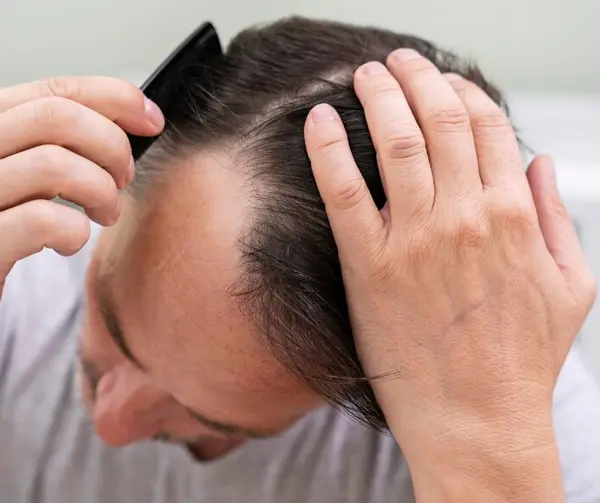
DHT hair loss usually follows a predictable pattern rather than causing random hair fall across the scalp. The affected hair does not disappear suddenly. It gradually becomes thinner, shorter, and weaker with every growth cycle. This slow shrinking of hair follicles is called follicle miniaturisation.
In men, this type of hair loss commonly appears as:
- Receding hairline
- Temple thinning
- Crown thinning
- Bald patches on the top of the scalp
In women, DHT-related hair loss usually appears as:
- Diffuse thinning on the top of the scalp
- Widening of the middle partition
- Reduced overall hair volume
- Crown thinning
Is Hair Transplant the First-Line Treatment for DHT Hair Loss?
Hair transplant is not usually the first-line treatment for every patient with DHT hair loss. In the early stages, when hair follicles are still active but weak, medical treatment may help control hair fall and improve hair thickness.
Doctors may first recommend DHT blocker hair loss treatments, such as:
| Option |
Role in DHT Hair Loss |
| Minoxidil |
Supports growth and thickness. |
| Finasteride / DHT blockers |
Helps reduce DHT’s effect on follicles. |
| PRP therapy |
Supports weak but active follicles. |
| GFC therapy |
Helps improve hair strength and density. |
| Nutrition & scalp care |
Corrects deficiencies, dandruff, or scalp issues. |
| Natural DHT blocker foods |
Protein, leafy greens, nuts, seeds, zinc, iron, vitamin D, omega-3, and antioxidants support hair health. |
These non-surgical treatments for DHT hair loss are usually more helpful when the follicles are still alive. They may help preserve existing hair and delay further thinning, but they generally cannot restore hair in areas where follicles have already become inactive or the scalp has turned bald.
Expert Tip: Some foods are commonly discussed as natural DHT blocker foods, such as pumpkin seeds, green tea, flaxseeds, onions, tomatoes, and zinc-rich foods. These may support overall hair and scalp health, but they should not be considered a replacement for medical treatment.
When Does a Hair Transplant Become the Right Choice?
A hair transplant for baldness due to DHT is usually considered when medicines, PRP, GFC, diet support, and other non-surgical therapies are unlikely to give enough improvement. This is why a proper diagnosis is important before deciding whether the patient needs hair-loss medication, regenerative therapy, a hair transplant, or a combination treatment plan for a permanent solution to hair loss.
Hair transplant becomes a suitable and safe option mainly because of two reasons:
Hair is taken from the safe donor area: The donor hair is usually taken from the back or sides of the scalp, where follicles are generally resistant to DHT. These follicles are less likely to shrink or fall out after transplantation because of their sensitivity to DHT.
DR. KAPIL DUA — ISHRS-CERTIFIED HAIR TRANSPLANT SURGEON, AK CLINICS
“In a hair transplant, we take hair follicles from the patient’s safe donor area, usually the back of the scalp. This area is generally non-responsive to DHT, so the transplanted hair has a better chance of growing naturally and giving long-lasting results.”
The patient’s own hair is used: Since the transplanted follicles come from the patient’s own scalp, the body accepts them naturally. There is no risk of graft rejection like in an organ transplant.
The success of a hair transplant depends not only on the number of grafts but also on donor area selection, hairline design, graft handling, implantation angle, and proper aftercare. That is why surgeon-driven hair transplantation is important for achieving natural and long-lasting results.
How Hair Transplant Works for DHT Hair Loss
The process is customised according to the patient’s androgenetic alopecia pattern, baldness grade, donor density, hair calibre, scalp laxity, age, and future risk.
In DHT-related cases, doctors carefully assess:
- Miniaturisation level: To check whether the existing hair can still respond to medicines or needs restoration.
- Safe donor zone: To extract grafts from areas that are generally more resistant to DHT.
- Hairline design: To create a natural hairline that suits the patient’s age and future hair loss pattern.
- Graft planning: To decide how many grafts are needed for the hairline, mid-scalp, or crown.
- Existing hair protection: To avoid damage to weak native hair during implantation.
- Post-transplant care: Washing instructions, medicines if advised, and follow-up visits. For detailed instructions, refer to our guide on post-operative care after a hair transplant.
- Medical maintenance: To control further DHT-related thinning after the transplant.
In a Bio-FUE hair transplant, grafts are carefully extracted, properly preserved, and implanted at the right angle, in the right direction, and at the right density. Since DHT hair loss can affect non-transplanted hair, the surgical plan is often combined with medications or regenerative therapies to support long-term results.
Hair Transplant Cost for DHT Hair Loss
The cost of hair transplant for DHT hair loss in India usually ranges from ₹60,000 to ₹3,50,000, depending mainly on the number of grafts required. The procedure cost varies significantly with graft count because each patient has a different baldness grade, donor area strength, and coverage needs.
Cost may vary based on:
- Number of grafts required
- Grade of baldness
- Area to be covered, such as hairline, temples, mid-scalp, or crown
- Donor area quality
- Technique used, such as FUE or Bio-FUE
An additional cost may apply if the surgeon recommends supportive treatment for DHT hair loss, such as minoxidil, finasteride, PRP, GFC, regenerative therapy, or treatment for any scalp-related concern. These are advised based on the patient’s condition and long-term hair preservation needs.
At AK Clinics, the final cost is shared after a detailed consultation, so patients understand the expected coverage, recovery, result possibilities, and long-term maintenance needs before surgery. For a detailed cost analysis, city-wise pricing, and graft-wise estimates, you can refer to our complete guide to hair transplant costs in India.
Recovery After Hair Transplant for DHT Hair Loss
Recovery after a hair transplant for DHT hair loss mainly focuses on graft protection and scalp healing during the first 10–14 days. Most patients can return to routine work within a few days, depending on the size of the procedure and the doctor’s advice.
| Timeline |
Post-Care Focus |
| First 24–48 hours |
Mild swelling, redness, or tightness may occur. Avoid touching, rubbing, or pressing the transplanted area. Sleep with the head slightly elevated if advised. |
| Day 3–5 |
The grafts begin to settle. Follow the prescribed spray, medicines, and washing instructions carefully. Avoid sweating, the gym, helmets, caps, and direct sun exposure. |
| Day 6–10 |
Small scabs may form around the grafts. Do not pick or scratch them. Gentle washing should be done only as instructed by the surgeon. |
| Day 10–14 |
Most scabs start falling off naturally. The scalp begins to look cleaner, and many patients can resume routine activities with the doctor’s approval. |
Read our blog to know more about the common side effects of hair transplant.
Role of DHT Blockers After Hair Transplant
In cases of DHT thinning, DHT blockers help protect existing non-transplanted hair. Finasteride may reduce the conversion of testosterone into DHT, which can slow further miniaturisation of weak follicles. Along with it, minoxidil may be advised to support hair growth, thickness, and overall density.
Together, finasteride and minoxidil can support more balanced long-term results around the transplanted area. They should be used only after consultation with a qualified hair transplant surgeon, as suitability, dose, and duration vary from patient to patient.
You can also read our detailed guide on the best medicines for DHT blocker treatment to understand which options may be suitable before or after a hair transplant.
Results After Hair Transplant for DHT Hair Loss
The results of a hair transplant for DHT hair loss are gradual and develop in stages. After the procedure, the transplanted follicles first settle into the scalp, then pass through a temporary shedding phase before new growth begins. Most patients notice visible improvement within a few months, while full density usually develops over 12–18 months.
| Timeline |
Hair Transplant Results |
| 2–4 weeks |
Temporary shedding of transplanted hair may occur. This is a normal phase and does not mean the grafts have failed. |
| 3–4 months |
New hair growth usually begins. The hair may look thin, soft, or uneven at first. |
| 6 months |
Visible improvement in hair coverage and density starts becoming noticeable. |
| 9 months |
Hair becomes thicker, stronger, and more natural-looking. |
| 12 months |
Most patients see significant improvement in hair transplant results. |
| 12–18 months |
Final results are usually visible, especially in crown hair transplant cases, where growth may take longer. |
The final outcome depends on donor area quality, graft survival, baldness grade, hair calibre, implantation angle, scalp health, and follow-up care.
Medical Note
In hormonal hair loss, recovery is not only about healing after surgery. The hair transplant before-and-after results should be viewed as part of a long-term hair restoration plan. If this progression is not controlled, the transplanted hair may still grow, but the overall result can look uneven, less dense, or patchy over time.
Why DHT Makes Hair Transplant Planning More Critical
As surgeons, when we treat dihydrotestosterone-related hair loss, we always caution patients that the condition is progressive. A hair transplant can restore bald areas, but it does not stop DHT from affecting untreated native hair.
- Ongoing loss: Baldness can increase over time.
- Native hair risk: Existing hair may still thin due to DHT.
- Limited donor grafts: Use them wisely.
- Hairline ageing: Very low hairlines may look unnatural later.
- Young patients: Ongoing hair loss requires careful timing and planning.
- Realistic density: Results depend on donor availability.
- Maintenance needs: Existing hair may need medical support.
At AK Clinics, patients are counselled by experienced doctors on what can be achieved, any limitations, and the post-transplant care that may be needed.
Did You Know? 2026 Hair Transplant Developments
In 2026, patients are increasingly looking beyond graft numbers. The focus is shifting toward natural-looking results, safer planning, better graft handling, regenerative support, and long-term hair preservation. Global discussions in hair restoration now highlight personalised planning, biologically supported recovery, and the role of regenerative treatments such as PRP and exosome-based therapies in selected cases.
Have you already reached an advanced stage of DHT hair loss, or are you worried that your thinning may worsen if treatment is delayed?
Why wait? Book your consultation at AK Clinics today.
Visit AK Clinics or call/WhatsApp +91 97799 44207 for a detailed scalp assessment, DHT planning, cost estimate, recovery guidance, and a discussion of expected results with our hair transplant doctors.
Frequently Asked Questions
Early DHT hair loss may improve with medicines and non-surgical treatments if the follicles are still active. However, once the follicles become inactive or the area becomes completely bald, natural reversal is unlikely, and a hair transplant may be considered.
DHT hair loss usually follows a pattern, such as a receding hairline, temple thinning, crown thinning, or gradual thinning on the top scalp. A doctor can confirm it through a scalp examination, a hair pull test, trichoscopy, a review of medical history, and an assessment of hair loss pattern.
Transplanted hair is usually taken from the back or sides of the scalp, where follicles are generally more resistant to DHT. As a result, transplanted hair is less likely to be affected by DHT. However, DHT can still affect the existing non-transplanted hair around it.
Some patients may need minoxidil after a hair transplant to support existing native hair, especially if DHT-related thinning is still active. It should be used only if advised by the doctor.
The best hair transplant clinic for DHT hair loss is one that offers doctor-led planning, proper diagnosis, safety checks, realistic result counselling, donor preservation, and long-term hair loss management.
Hair transplant in young patients with DHT hair loss needs careful evaluation because hair loss may still be ongoing. For many young patients, doctors may first recommend medications or non-surgical treatments to stabilise hair loss before considering surgery.
Medical Disclaimer: This article is written by Dr Kapil Dua for educational purposes, based on clinical experience and published literature. It does not constitute personalised medical advice, diagnosis, or treatment. Hair loss causes and treatment suitability vary from person to person. Always consult a qualified dermatologist or hair transplant surgeon before starting, changing, or stopping any hair loss treatment.











Leave a Comment