Medical Disclaimer: This article is for informational purposes only and does not replace medical advice. Hair loss can have multiple causes, and treatment suitability varies from person to person. Always consult a qualified dermatologist or hair restoration doctor before starting medicines, PRP, GFC, or hair transplant treatment.
Best Hair Loss Treatments for DHT Hair Loss: Overview
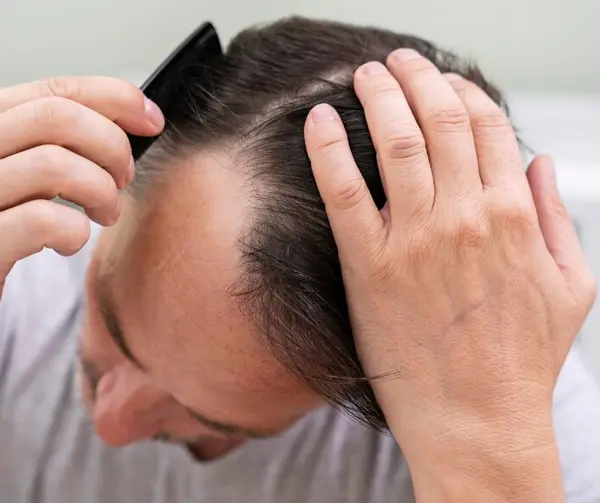
DHT hair loss is different from regular hair fall. It happens when genetically sensitive hair follicles react to DHT, gradually becoming thinner, weaker, and less active over time. This process is called follicle miniaturisation. As a result, if treatment is delayed, the affected follicles may stop producing visible hair, leading to a receding hairline, crown thinning, or bald patches.
The best treatment for DHT hair loss depends on the stage. Early hair loss is usually managed with medications and DHT control; thinning areas may benefit from PRP or GFC, while bald areas usually require a hair transplant because lost follicles cannot be regenerated.
At AK Clinics, our hair restoration doctors look beyond visible hair loss to understand the underlying cause, including DHT sensitivity, hormonal imbalance, pattern thinning, and follicle miniaturisation. This helps us plan the right treatment for DHT-related hair loss, from early to advanced stages, including medical support, regenerative therapies, and DHT-blocking hair loss treatment where suitable, with a focus on preserving existing hair and delivering natural-looking, long-term results.
Why DHT Hair Loss Should Be Treated Early
Dihydrotestosterone-related hair loss is usually progressive. It often begins slowly, with increased shedding, mild thinning, or a receding hairline, and may worsen over time if left untreated.
In the beginning, the hair follicles are still present but gradually become weaker. They produce thinner, shorter, and finer hair with each growth cycle. This is why it’s important to understand what DHT is and how it affects the hair growth cycle before choosing any treatment.
OUR CHIEF DERMATOLOGIST EXPLAINS
“In hormonal hair loss, treatment should be planned according to the stage. Medicines may help slow progression in early cases, PRP or GFC can support thinning areas where follicles are still responsive, and hair transplant is considered when bald areas no longer have active follicles. A scalp evaluation is important before deciding on the treatment.”
Stage-Wise Treatment for DHT Hair Loss
| DHT Hair Loss Stage |
What Happens to the Follicle |
Treatment Goal |
| Early thinning |
Follicles are sensitive to DHT but active |
Slow progression |
| Visible thinning |
Follicles are weak and miniaturised |
Support follicle health |
| Receding hairline |
Some follicles may be inactive |
Check if restoration is needed |
| Crown thinning/baldness |
Density is reduced, or roots are lost |
Restore coverage if needed |
| Advanced baldness |
Follicles are lost in bald areas |
Doctor-led Hair Transplant Planning |
Hair Loss in Women
Hormonal hair loss can look different in women. Instead of a clear receding hairline, many women notice widening of the hair part, reduced ponytail thickness, or diffuse thinning. This is why androgenetic alopecia treatment in women needs careful evaluation, especially when PCOS, thyroid issues, iron deficiency, or hormonal imbalance may be involved.
Medical Tip: Hair products such as
DHT-blocking shampoos may help maintain scalp hygiene and reduce dandruff or inflammation, but they cannot reverse advanced male/female pattern hair loss or restore bald patches.
Medications for Early DHT Hair Loss
In early hereditary hair loss, medicines such as finasteride, dutasteride, or minoxidil may help slow further thinning. They usually help control progression, not restore hair in areas where follicles are already lost.
However, medicines alone may not be enough when hair thinning becomes visible or when density starts to reduce. This is where doctors consider PRP or GFC to support thinning areas.
Best suited for:
- Recent hair fall
- Early thinning
- Early crown thinning
- Progressive DHT-related hair loss
Read here to know the best medicines for DHT Blockers in the early stages of hair loss.
May not be enough when:
- Hairline recession is clearly visible
- Scalp visibility is increasing
- Crown thinning has widened
- Bald patches have formed
Patients in the early stage can refer to our guide on minoxidil vs DHT blockers to help understand how medical options work before choosing advanced treatments.
Can Natural DHT Control Help?
Natural methods may support scalp and hair health in early-stage hair thinning. However, they should not replace medical diagnosis or treatment when hair thinning is progressing. Some patients may explore natural DHT-blocking foods, lifestyle changes, or other ways to reduce DHT as supportive measures.
Patient Query: Do You Need a DHT Blood Test?
Your dermatologist may suggest a DHT blood test for hair loss if hormonal imbalance, PCOS, thyroid issues, iron deficiency, sudden hair fall, or unusual thinning is suspected. However, a DHT test alone does not confirm DHT-induced hair fall. Doctors also check your scalp, hair loss pattern, family history, and the stage of thinning before planning treatment.
PRP for DHT Hair Loss Treatment
PRP hair treatment is not a DHT blocker. It does not stop the hormone from affecting follicles. Instead, PRP supports follicles that are still present but weakened by DHT-related miniaturisation.
- Before PRP: The doctor assesses the stage of genetic hair loss, scalp density, thinning pattern, medical history, and suitability for PRP.
- During PRP: Blood is collected (around 40–60 cc), processed in a centrifuge, and PRP is injected into targeted thinning areas.
- After PRP: Mild redness or sensitivity may occur. Improvement may begin after 2–3 sessions in suitable patients, but multiple sessions may be needed.
Best suited for:
- Early to moderate thinning
- Diffuse thinning
- Early crown thinning
- Miniaturised but active follicles
- Support after hair transplant
Not suitable for: Completely bald areas where follicles are already lost.
GFC Treatment for Hair Loss
GFC treatment for hair loss is a regenerative option for DHT-caused thinning. Like PRP, it does not directly reduce DHT. It delivers concentrated growth factors to support follicles weakened by DHT-related miniaturisation and may help improve hair quality in suitable patients.
- Before GFC: The doctor evaluates scalp density, thinning areas, medical history, and whether GFC should be used alone or with other treatments.
- During GFC: A blood sample is collected around 12–16 mL), growth factors are separated through a specialised process, and GFC is injected into thinning areas.
- After GFC: Mild sensitivity may occur for a short time. Hair quality and thickness may improve gradually in suitable patients. The doctor may advise follow-up sessions.
Best suited for:
- Early to moderate DHT thinning
- Reduced hair density
- Crown thinning where hair is still present
- Patients needing regenerative support
Not suitable for: Bald patches where follicles are permanently lost.
Like PRP, GFC cannot restore hair in areas where follicles are permanently lost. It is best for improving existing weak follicles, not replacing absent follicles.
PRP vs GFC: What Is the Difference?
PRP contains platelets suspended in plasma, while GFC focuses on extracting and concentrating growth factors. In clinical practice, GFC is often presented as more standardised and comfortable, though the published evidence base for PRP is broader. Early studies on growth factor concentrates and concentrated growth factor therapies suggest potential benefit in androgenetic alopecia, including improvements in hair density or diameter, but the evidence remains developing and less established than that for conventional medical therapy.
How Many PRP or GFC Sessions Are Needed?
The number of PRP or GFC sessions varies from patient to patient. It depends on:
- Stage of hair loss
- Scalp condition
- Follicle responsiveness
- Medical history
- Severity of thinning
- Consistency with follow-ups
- Use of supporting medicines, if prescribed
Some patients may notice reduced hair fall or improved hair texture earlier, while others may need multiple sessions before a visible improvement in thickness or density is seen. A doctor can provide a clearer session plan.
2026 Update
Emerging options, including topical finasteride, PRF, exosome-based therapies, conditioned media, and stem-cell-based approaches, are being studied for androgenetic alopecia. These may support selected patients, but they do not replace proper diagnosis, DHT control, or hair transplant where follicles are already lost.
Hair Transplant for Advanced DHT Hair Loss
A hair transplant works by redistributing healthy follicles from the donor area, usually the back or sides of the scalp, and implanting them into bald or low-density areas. These transplanted follicles continue to grow naturally because the donor hair is usually more resistant to DHT.
Modern FUE hair transplant is commonly preferred because the surgeon removes follicles individually via careful graft extraction, leaving no long linear scar. A successful hair transplant result depends on careful donor area planning, graft selection, hairline design, recipient site creation, implantation angle, and density placement.
At AK Clinics, we perform Bio-FUE™ hair transplant, our trademark procedure that focuses on careful graft extraction, safe graft preservation, controlled implantation, reduced tissue trauma, and natural-looking hair restoration.
- Before hair transplant: Scalp evaluation, donor area assessment, hairline design, graft planning, and cost discussion.
- During hair transplant: Healthy follicles are extracted, preserved, and implanted into bald areas according to natural direction and density.
- After a hair transplant, temporary redness, scabbing, or shedding may occur. New growth appears gradually, and fuller results usually develop in 8–12 months.
Hair Transplant Benefits
- Restores hair in bald areas
- Gives long-term, natural-looking results
- Uses your own hair follicles
- Suitable for advanced hair loss
- Can rebuild hairline, temples, crown, and density
- Results continue improving over the months
Expert Advice
Hair transplant does not stop future DHT-related hair loss in non-transplanted hair. That is why a maintenance plan is important after a transplant. Our doctors plan a hair transplant for pattern hair loss with long-term hair preservation in mind, not just immediate coverage. Doctors may recommend maintenance therapy such as minoxidil, finasteride, PRP, GFC, or other personalised treatments after surgery.
PRP vs GFC vs Hair Transplant
When patients compare PRP, GFC, and hair transplant in India, cost is often a primary concern. However, the best treatment should be chosen based on medical criteria, not just price.
Hair transplant costs more initially because it involves donor area planning, graft extraction, graft preservation, and implantation. However, it may offer a stronger restoration option for areas where hair roots have already been lost. Read the table below to know better—
| Factor |
PRP |
GFC |
Hair Transplant |
| Best suited for |
Early to moderate thinning |
Early to moderate thinning |
Bald patches, receding hairline, crown baldness, and advanced hair loss |
| Main role |
Supports thinning areas and hair quality |
Provides concentrated growth factor support |
Restores hair where roots are already lost |
| Cost |
Lower upfront cost, may need sessions |
Lower upfront cost, may need repeat sessions |
Higher upfront cost, stronger long-term restoration option for bald areas |
| Recovery |
Minimal downtime |
Minimal downtime |
Short recovery period with post-care; temporary redness/scabbing may occur |
| Result timeline |
Improvement may start after 2–3 sessions |
Improvement may start after 2–3 sessions |
New growth starts gradually; fuller results usually appear in 8–12 months |
| Limitation |
Cannot restore fully bald areas |
Cannot restore fully bald areas |
Requires good donor area and surgical planning |
For many patients, the best plan may involve a combination approach based on scalp evaluation.
Hair Loss Treatment Before and After Results
Before-and-after results depend on the stage of genetic hair loss and the treatment chosen.
- PRP and GFC before-and-after results typically show increased hair thickness, reduced shedding, and improved scalp coverage in thinning areas.
- Hair transplant before-and-after results are more visible in bald areas, especially in the hairline, temples, and crown.
As a patient, you should compare results only with similar cases, such as age, baldness grade, donor area, graft count, and treatment type.
Why Choose AK Clinics for DHT Hair Loss Treatment?
At AK Clinics, hair loss treatment is not based solely on the procedure name. The focus is on procedure safety, graft protection, infection control, and natural-looking outcomes at every step.
For PRP and GFC, we use in-clinic preparation protocols, dedicated centrifuge systems, and sterile processing methods. This helps keep the patient’s blood sample fresh, reduces unnecessary handling time, and supports safer preparation before the treatment is injected into the scalp.
In addition, for Bio-FUE™ hair transplant, we perform our own customised technique, specialised tools, and careful graft-handling protocols. We believe successful hair restoration is not only about adding hair but also about protecting existing hair and planning for results that look and feel natural.
Our USP:
- Dedicated centrifuge systems for PRP/GFC preparation
- Sterile, ISHRS-aligned handling protocols to reduce infection risk
- Faster sample processing to help maintain freshness
- Bio-FUE™ technique developed by our team of doctors
- Customised tools for careful graft extraction and implantation
- PRP, GFC, and Bio-FUE™ under one roof
- Transparent treatment discussion
- Clinics in Delhi, Ludhiana, and Bangalore
Not sure whether your hair loss needs PRP, GFC, medicines, or a hair transplant? Book a consultation at AK Clinics. Our hair restoration experts will identify the stage of your hair loss and recommend a personalised treatment plan for long-term, natural-looking results.
FAQs
The best treatment depends on the stage. Early hair loss may require medication, visible thinning may require PRP or GFC, and bald patches may require a hair transplant.
PRP and GFC can support thinning areas, but they do not directly block DHT. They may be combined with medicines when DHT control is needed.
GFC uses concentrated growth factors, while PRP uses platelet-rich plasma. The better option depends on scalp condition, stage of hair loss, and the doctor’s evaluation.
Yes, many patients need maintenance to protect existing non-transplanted hair because DHT can still affect native hair.
Foods rich in zinc, lycopene, antioxidants, and healthy fats may support scalp and hormone health. Pumpkin seeds, green tea, tomatoes, flaxseeds, walnuts, almonds, spinach, and berries are often included in a hair-friendly diet. However, foods alone cannot reverse advanced hormonal hair loss or regrow hair in bald patches.
Medical Disclaimer: This article is for informational purposes only and does not replace medical advice. Hair loss can have multiple causes, and treatment suitability varies from person to person. Always consult a qualified dermatologist or hair restoration doctor before starting medicines, PRP, GFC, or hair transplant treatment.










Leave a Comment