







AK Clinics
AK Clinics- India most trusted & recommended Hair, Skin, Cosmetic Surgery Clinics in India run by Dr. Kapil Dua & Dr. Aman Dua with a mission empowering one million indians to look and feel their best.
⚕️
If you have been searching for a way to boost hair growth at home, you might have come across the derma roller, also known as a scalp dermaroller or microneedle roller. This device creates tiny, controlled punctures in the scalp that trigger the skin’s natural repair process, improve blood flow to hair follicles, and allow topical treatments to penetrate more deeply.
When used alongside minoxidil or other prescribed topical treatments, research has shown improvements in hair count far beyond what either approach achieves alone.
That said, the right technique is important. If used improperly, the device can damage healthy follicles, cause scalp infections, and increase hair loss. In clinical practice at AK Clinics, we observe that many people who use derma rollers at home make avoidable mistakes, especially with the frequency, timing, and maintenance of the roller.
This guide covers everything you need: the right needle size, the correct rolling technique, how often to roll, what to apply after microneedling, and when at-home rolling is no longer enough.
Table of Contents
A derma roller is a small handheld device with a cylindrical head covered in hundreds of fine, medical-grade needles, typically made of surgical-grade stainless steel or titanium. When rolled across the scalp, those needles create thousands of micro-injuries in the skin’s surface.
These injuries are too small to cause real damage, but large enough for the scalp to recognise them as injuries and trigger its natural healing response. When the scalp heals, it increases blood circulation to the area, releases growth factors that activate dormant follicles, and produces new collagen around the hair root. At the same time, the micro-channels improve the depth to which any topical treatment penetrates the scalp.
Dr Kapil Dua, FISHRS, ABHRS-Certified — Hair Restoration Surgeon, AK Clinics
“Derma rollers work by creating controlled micro-injuries on the scalp. These tiny injuries temporarily open the scalp channels, which can improve the absorption of topical solutions. The micro-trauma also stimulates the production of natural growth factors, helping support hair growth. This is why, in some cases, combining microneedling with treatments like PRP, GFC, and mesotherapy may give better results than doing these treatments alone.”
In androgenetic alopecia, the most common form of pattern hair loss, hair follicles gradually miniaturise under the influence of DHT. Microneedling cannot reverse this hormonal process on its own, but it helps prescribed treatments reach the follicle more effectively. Read our guide on DHT blockers for hair loss for more context.
Is Derma Rolling the Same as Microneedling?
Essentially yes. Clinical microneedling uses motorised devices with greater depth control. At-home rolling uses shorter needles and manual pressure. Both work on the same principle, but clinical microneedling in a professional setting tends to produce stronger, more consistent results.
The honest answer is yes, particularly when used as part of a broader treatment plan rather than as a standalone solution.
The most-cited study on this topic followed 100 men with pattern hair loss for 12 weeks. Half used topical minoxidil alone. The other half added weekly microneedling sessions to the same routine. By the end of the study, the combination group showed four times more improvement in hair count than the minoxidil-only group.
A systematic review published in 2025 confirmed these findings across multiple studies. The researchers found that microneedling consistently increases both the absorption rate and the onset of action of minoxidil, with combined treatment producing significantly improved hair count and thickness. A separate 2024 study found that it also boosts the effectiveness of non-prescription hair growth treatments.
What research also makes clear is that this only works when follicles are still active. In areas where follicles have completely stopped functioning, a derma roller alone cannot restore growth. For hair loss at that stage, a hair transplant is required to restore coverage.
Most people who try at-home microneedling do not see meaningful results, and a significant number make their hair loss worse rather than better. The mistakes are almost always the same: rolling too often, applying treatments at the wrong time, failing to replace the roller, or working on the wrong part of the scalp.
At AK Clinics, our dermatologists often observe people making these errors. Here are the mistakes and the correct ways to use it.
Many people assume more coverage means better results, so they work across the entire scalp, including areas where hair is growing normally. Rolling on a healthy, non-thinning hairline does not stimulate growth. It damages perfectly functional follicles, irritates the skin near the face, and causes harm where there was no problem. Only roll on areas with actual thinning or hair loss.
The scalp needs time to recover between sessions. The healing response that rolling triggers is precisely where the benefit comes from. When you roll daily, you prevent that recovery from completing. Instead of growth stimulation, you get chronic micro-inflammation, scalp sensitivity, and in some cases folliculitis, a painful infection of the hair follicles.
This is perhaps the most widespread misconception. Many guides suggest applying minoxidil straight after a session while the channels are fresh. In practice, topical minoxidil contains alcohol, which can burn and sensitise a freshly treated scalp.
The correct approach is to roll on one day, then apply minoxidil or a dermatologist-prescribed topical treatment the following day, when the micro-channels are still partially open, but the initial sensitivity has settled.
The device has a lifespan of roughly four uses. After that, the needles have become blunt. They no longer create clean micro-channels. Instead, they tear the skin, causing more damage and less of the precise stimulation that produces results. A used roller also accumulates bacteria between sessions, increasing the risk of infection.
Rolling over dandruff, seborrhoeic dermatitis, folliculitis, or any area with open wounds dramatically increases the risk of infection. The micro-channels created are temporary entry points into the scalp. Always work on a clean, fully dry scalp, and skip a session entirely if you are having an active flare-up of any scalp condition.
Needle size determines how deep the micro-channels penetrate and how intense the scalp’s healing response is. Longer is not always better, especially at home.
| Needle Size | Best For | Frequency | Home Use? |
|---|---|---|---|
| 0.25 mm | Enhancing topical absorption, minimal stimulation | Once a week | Yes, safest for beginners |
| 0.5 mm | Early to mild thinning, stimulation and absorption | Once a week | Yes, most recommended |
| 0.75 mm | Moderate thinning, stronger stimulation | Once a week | Yes, use with caution |
| 1.0 mm | Moderate to significant thinning | Once a week only | Doctor’s guidance advised |
| 1.5 mm | Significant stimulation, size used in key clinical study | Once every 2 to 3 weeks | Clinic recommended |
| Above 1.5 mm | Deep clinical scalp treatment | Clinician directed | No, clinic only |
Start with 0.5 mm. It is effective for early- to moderate-stage thinning, is significantly safer at home, and causes much less post-session redness and sensitivity. The 1.0 mm size provides stronger stimulation and may be appropriate for more established thinning, but requires more careful technique. Consult your dermatologist before moving to 1.0 mm.
Before you begin, sterilise the derma roller by soaking it in 70% isopropyl alcohol for 5 to 10 minutes. Shake off excess alcohol and let it air-dry on a clean surface. Do not wipe it with a cloth.
Wash your hair with a gentle shampoo and dry your scalp completely. Do not use a derma roller on a wet or damp scalp, as it can increase irritation.
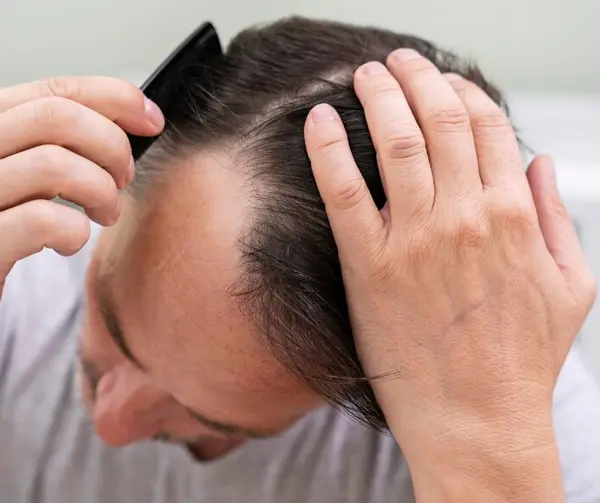
Use a comb or clips to identify areas of actual thinning or hair loss. These are the only areas you should treat. Read our guide on the causes of female hair loss and treatment to help identify the correct areas for women.
Roll each section with light pressure in four directions: vertical, horizontal, and both diagonals. Make 4 to 5 passes in each direction. Mild tingling is normal, but pain is not.
Do not apply minoxidil, oils, serums, or other treatments on the same day. Let the scalp heal undisturbed.
Rinse the roller under warm water, soak again in 70% isopropyl alcohol for 5 to 10 minutes, air-dry fully, and store it in its case. Never share your roller with anyone.
Dr Kapil Dua, FISHRS, ABHRS-Certified — AK Clinics
“For most patients, derma rolling should not be done more than once a week, irrespective of needle size. The scalp needs adequate time to complete its healing response after each session. This healing phase is when controlled stimulation supports follicle activity. Repeating sessions too soon can increase inflammation, irritation, and scalp sensitivity instead of improving growth outcomes.”
| Needle Size | Recommended Frequency | Minimum Healing Time |
|---|---|---|
| 0.25 mm to 0.5 mm | Once a week | 7 days between sessions |
| 0.75 mm to 1.0 mm | Once a week, maximum | 7 days minimum |
| 1.5 mm | Once every 2 to 3 weeks | 14 to 21 days |
On rolling day, avoid:
From the day after rolling, resume normally:
Using a derma roller incorrectly can damage the scalp and worsen hair fall. Common risks include:
This technique is not appropriate for everyone. Do not use a derma roller if you have an active scalp infection, open wounds, psoriasis, eczema, or seborrhoeic dermatitis.
| Factor | At-Home Rolling | Clinical Microneedling with PRP or GFC |
|---|---|---|
| Needle depth | 0.25 to 1.0 mm, home safe range | 1.0 to 2.5 mm with motorised precision |
| Consistency | Variable, depends on technique | Consistent depth, clinician-controlled |
| What goes through the channels | Prescribed topicals the following day | PRP or GFC, direct growth factor delivery |
| Best suited for | Early thinning, weekly maintenance | Moderate to established hair loss |
| Approx. cost in India | Rs. 300 to 1,500 per roller (every 4 sessions) | Rs. 3,000 to 12,000 per clinical session |
| Risk | Depends on user hygiene and technique | Lower, sterile, clinician-supervised |
At AK Clinics, many patients with early-stage hair loss combine at-home rolling between their clinical sessions. If you are uncertain about the right level of care for your stage, our hair loss planning guide can be a helpful starting point.
| Timeframe | What to Expect |
|---|---|
| Weeks 1 to 4 | The scalp appears slightly redder after sessions. Some temporary increased shedding is normal and usually settles on its own. |
| Weeks 8 to 12 | First visible changes: reduced shedding, fine new hair growth in thinning areas, improved scalp health and texture. |
| Months 3 to 4 | Noticeable improvement in hair density when combined with a prescribed topical treatment. Fine regrowth begins to thicken. |
| Months 4 to 6 | Clear density gains visible in the crown and mid-scalp where follicles remained active. Best results with a combined treatment plan. |
Expert Advice
Microneedling is a supportive tool in the early stages, but not a cure for advanced baldness. For more advanced hair loss, the next step is a clinical consultation to assess whether medical and regenerative treatment or advanced restoration is needed.


AK Clinics- India most trusted & recommended Hair, Skin, Cosmetic Surgery Clinics in India run by Dr. Kapil Dua & Dr. Aman Dua.


Leave a Comment